
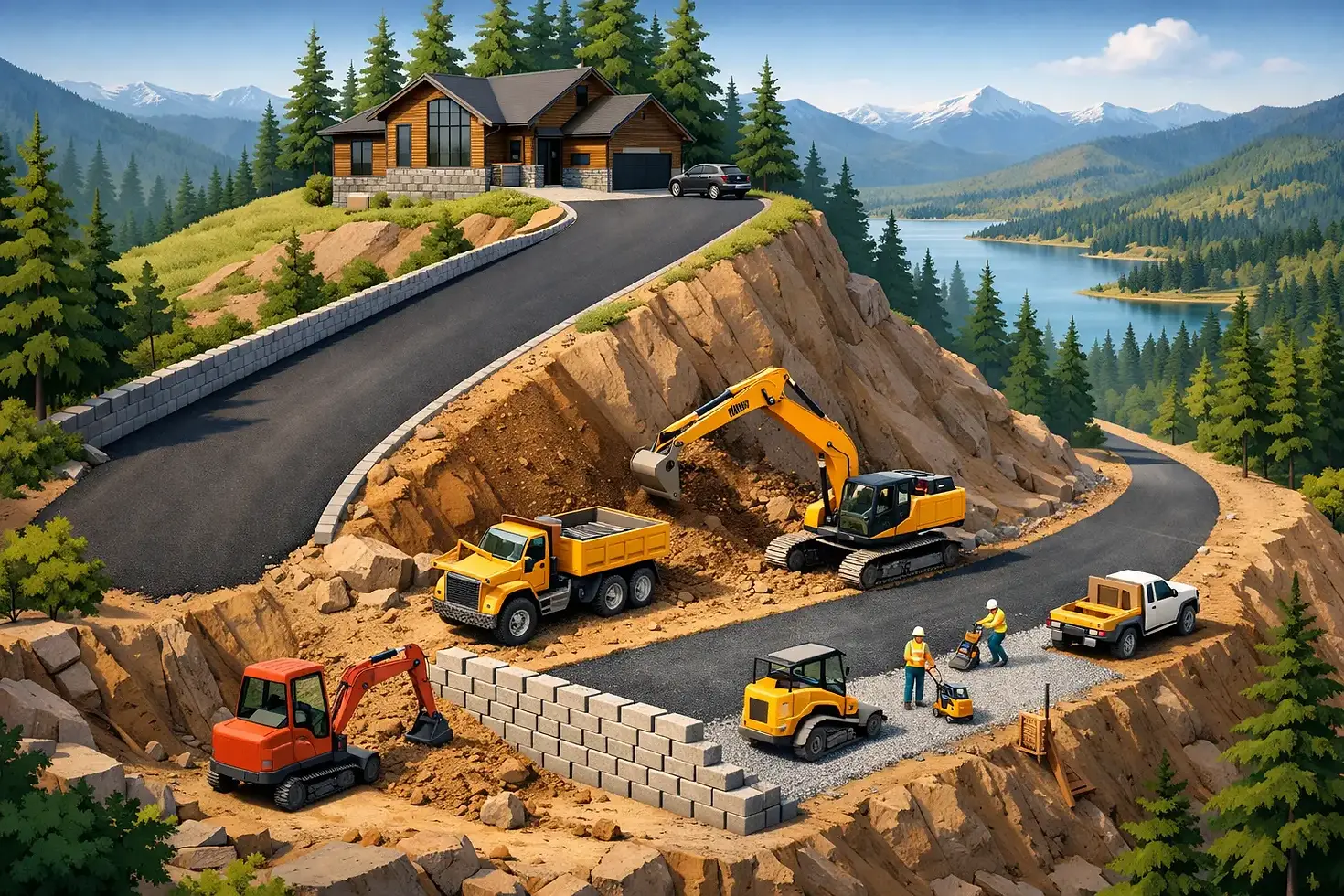
Steep Driveway Construction for North Idaho Homes
A steep driveway can make a mountain property feel private, elevated, and perfectly suited to North Idaho. It can also become the feature that determines whether you reach the house comfortably in January, whether water stays out of the garage, and how efficiently the home can be built. Successful steep driveway construction starts well before concrete, asphalt, or gravel is installed. It begins with a clear understanding of the land, the weather, and how the property will work every day.
For homeowners building near Sandpoint or elsewhere in North Idaho, the goal is not simply to create a route from the road to the home. The goal is to build dependable access that handles snow, runoff, vehicles, emergency access, and the long-term demands of a finished residence.
Start With the Property, Not the Pavement
A driveway grade that looks manageable on a site visit can present very different challenges once snow, ice, spring runoff, and construction traffic enter the picture. Before deciding on a route, a builder should evaluate the property’s natural contours, soil conditions, road access, drainage paths, trees, rock, and the proposed home location.
The shortest route is not always the best route. A more gradual alignment with a curve or switchback may require additional excavation and clearing, but it can substantially improve winter traction and daily comfort. In some cases, shifting the home location slightly can reduce driveway cost and avoid an overly aggressive climb.
This early planning is where site knowledge matters most. The driveway, building pad, retaining needs, utility routes, and drainage system should be considered together. Treating them as separate projects often creates expensive corrections later, especially when water has nowhere appropriate to go.
Steep Driveway Construction Depends on Grade
Driveway slope is commonly discussed as a percentage. A 10 percent grade rises 10 feet over 100 horizontal feet. While a steeper driveway may be physically possible, practical limits depend on the driveway length, curves, surface material, local conditions, and the vehicles that need to use it.
For a North Idaho home, a grade that feels acceptable during a dry summer can be difficult during a freeze-thaw cycle. Snow compaction, shaded areas, and packed ice all reduce traction. Delivery trucks, service vehicles, guests unfamiliar with the property, and a vehicle pulling a trailer may need more forgiving access than the homeowner’s daily driver.
The transition areas deserve special attention. The point where a driveway leaves the public road and the approach near the garage can be more troublesome than the main run of the drive. Abrupt changes in grade can cause vehicles to bottom out, scrape trailers, or lose traction. A well-designed driveway uses gradual vertical transitions rather than sharp breaks.
Drainage Is the Work That Protects the Driveway
Water is one of the biggest threats to any driveway, and steep sites move water quickly. Without deliberate drainage planning, runoff can wash gravel downhill, erode shoulders, undermine pavement edges, saturate the base, or direct water toward the foundation.
The surface should shed water without concentrating it into damaging channels. Depending on the site, the plan may include crowned or cross-sloped surfaces, roadside swales, ditching, culverts, drain basins, and controlled outlets that move water away from the drive and home. Water should never be solved by simply sending it toward a neighboring property or the public road.
Subsurface drainage can be just as important. A stable driveway base needs separation from wet native soils and may require properly installed drainage rock, geotextile fabric, and edge support. The right approach depends on the soil and groundwater conditions. A driveway built on a saturated base can fail even when the surface initially looks well finished.
In spring, melting snow can expose weaknesses that were hidden all winter. Planning for that season from the beginning protects the driveway and reduces maintenance demands for years to come.
Choose a Surface for Traction and Maintenance
There is no single best driveway material for every steep property. The right choice balances budget, slope, expected use, appearance, maintenance expectations, and winter performance.
Gravel can be a practical choice for long rural driveways, particularly when it is built over a properly compacted base with good drainage. It is also easier to repair in isolated areas. On a steep slope, however, loose material can migrate downhill during rain, snow removal, and repeated traffic. Well-graded aggregate, appropriate compaction, and periodic maintenance are essential.
Asphalt provides a smoother driving surface and can work well where the base is stable and drainage is controlled. It offers better traction than loose gravel in many conditions, but its edges and seams need protection from water intrusion. Asphalt also requires thoughtful snow-removal practices to avoid damage.
Concrete is durable and can be shaped with a textured finish to improve traction. It is often a strong choice for steep sections, garage approaches, and high-use areas. The trade-off is upfront cost and the need for careful base preparation, joints, drainage, and cold-weather installation practices. In a mountain setting, the details beneath and around the concrete are as important as the slab itself.
Some properties benefit from a combination of materials, such as a paved upper approach near the garage with a well-built gravel drive below. This can control cost while putting the most durable surface where traction and frequent use matter most.
Build for Snow Removal Before Winter Arrives
A driveway is only useful if it can be cleared safely. Snow storage should be part of the design, not an afterthought. Plowed snow needs a place to go without narrowing the driving path, blocking sightlines, damaging landscaping, or creating meltwater that refreezes across the driveway.
Adequate width gives drivers room to recover from a slight slide and gives snow-removal equipment space to operate. Curves need additional width, and turnarounds should be sized for the vehicles expected on the property. This includes fuel delivery, moving trucks, contractors, and emergency vehicles, not just passenger cars.
Shade also changes the equation. A north-facing or heavily treed driveway may hold ice longer than a sunny exposure. Sometimes selective tree work, a revised alignment, or a less severe grade is a better long-term solution than relying on sand, de-icer, or tire chains every winter.
Retaining Walls Need Engineering and Drainage
On sloped land, retaining walls can create usable driveway space and reduce the amount of excavation required. They can also become a major point of failure if they are installed without proper design, drainage, and footing support.
A retaining wall is not simply a landscape feature when it supports a driveway, vehicle loads, or soil near a home. The wall must account for the pressure of retained earth, water behind the wall, frost movement, and surcharge loads from vehicles above. Drainage rock, collection pipe, fabric, and a reliable outlet are often necessary to keep hydrostatic pressure from building behind the structure.
Wall height, soil conditions, and local requirements may call for engineered design and permits. This is not a place to cut corners. A failed wall can compromise the driveway, damage utilities, and create a costly safety issue.
Plan Construction Access Separately From the Finished Drive
Heavy equipment, concrete trucks, lumber deliveries, and repeated construction traffic place far more stress on a driveway than ordinary residential use. A temporary access route may be appropriate in some cases, while other sites require the finished driveway to be built in stages and protected throughout construction.
The construction sequence should account for weather as well. Building a steep access road during wet conditions can damage subgrade soils and lead to ongoing problems. It may be wiser to complete rough grading and drainage early, establish a stable construction surface, then install final paving or finish gravel after the major work is complete.
Sandpoint Home Builders approaches site preparation as part of the overall home-building strategy. With excavation knowledge involved from the early planning phase, decisions about the driveway can support the foundation, drainage, utility access, and finished exterior rather than working against them.
A Driveway Should Make the Home Easier to Live In
A steep driveway is a permanent part of how a property feels and functions. It affects the first arrival home in a snowstorm, the ease of bringing groceries inside, a guest’s confidence behind the wheel, and the protection of the investment below it.
The best time to solve access, grade, and drainage challenges is when the home is still being planned. A practical route, stable base, controlled runoff, and winter-ready surface turn difficult terrain into an asset that supports the home for decades.

Comments